

PowerPRO1000
- 50 Hz
- 500–1,000 kVA
- 60 Hz
- 500–1,000 kVA
The proven, compact system at the lower end of the range. Easy to maintain and well suited to mobile and containerised solutions.
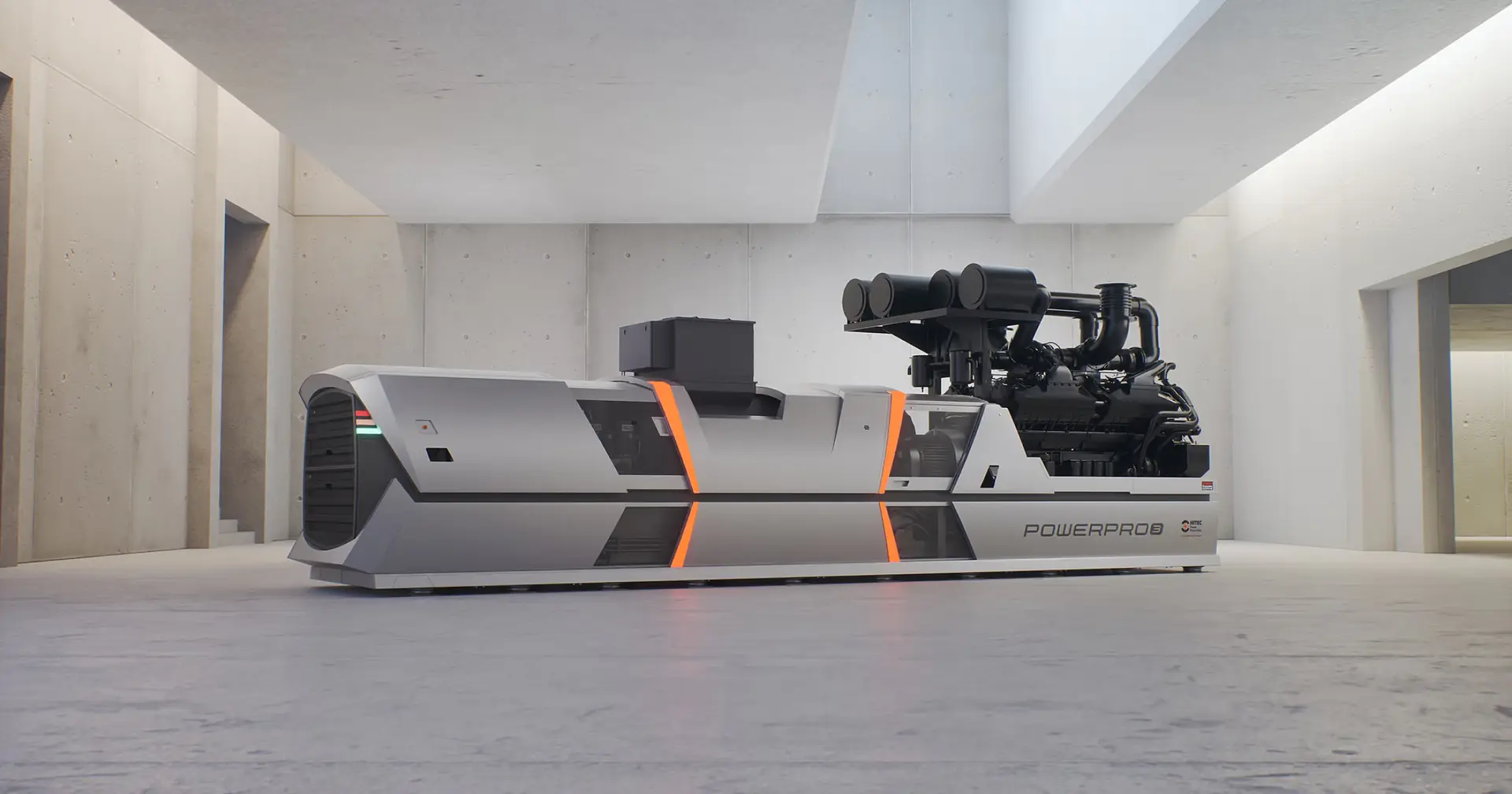
DRUPS · Diesel rotary UPS from HITEC
UPS, energy storage and standby generator combined in one machine. We explain how a DRUPS works and present every HITEC PowerPRO model, size and configuration.
Diesel Rotary UPS
A DRUPS replaces static UPS, batteries and standby generator with one machine: it cleans the utility supply, bridges outages and generates power for as long as there is fuel.
HITEC Power Protection in Almelo invented the dynamic UPS and has been building them for more than 65 years. The systems protect everything from servers to large motors, pumps, compressors, cooling and entire production lines – including the loads a battery UPS is rarely sized for.
How a DRUPS works
A diesel rotary UPS is line‑interactive: it runs in parallel with the utility without converting the energy, and stores energy as motion instead of chemistry. Choose an operating mode, or let the diagram run.
Power flows from the utility through the choke to the critical load. Choke and synchronous generator act together as an active filter that removes spikes, dips and harmonic distortion and supplies the reactive power. The generator runs as a motor and keeps the kinetic energy module fully charged.
Generator 1500/1800 rpm · energy module 3900/4200 rpm
Q1 opens and separates the system from the utility. The stored kinetic energy in the energy module is transferred to the generator, which holds its speed and thus voltage and frequency. At the same time the diesel engine starts. The load notices nothing.
The generator holds 1500/1800 rpm
The engine is up to speed in under 2 seconds, and the freewheel clutch engages automatically. For a few seconds engine and energy module drive the generator together; after 5–10 seconds the engine is the sole source. The energy module recharges and supports large load steps.
Engine at 1500/1800 rpm in under 2 seconds
The system synchronises with the utility and closes Q1. The engine slows down, the freewheel clutch disengages, and the generator returns to motor operation. The engine cools down at idle and is then ready again.
The engine drops to 1450/1750 rpm and disengages
Sequence at a utility failure
The components
The modules can work independently: engine and generator can run as a conventional genset while the energy storage is disconnected, and generator and energy storage can run as a rotary UPS while the engine is being serviced.
Kept preheated and ready for a short start and fast load acceptance. Available with emission‑optimised engines (EPA/TA Luft) and runs on diesel or HVO.
A robust, self‑lubricating mechanical clutch with no external control. It engages when the engine reaches the generator’s speed and transfers the power shock‑free.
The synchronous machine is matched to the load and the choke. It provides high short‑circuit capacity, so faults are cleared without going to bypass, and keeps the power factor close to 1.
The heart of the system: transfers the stored kinetic energy to the generator, so the supply is never interrupted.
Low‑speed flywheel (approx. 2900 rpm on the PowerPRO3600) in several sizes, matched to power and ride‑through time. The low speed allows long maintenance intervals.
The PowerPRO3 and PowerPRO2700 instead use a Kinetic Energy Module (KEM), in which storage and transfer are combined: the generator drives the outer rotor at 1500/1800 rpm, and the inner rotor speeds up to 3900/4200 rpm. At a utility failure the energy is transferred from the inner to the outer rotor via the DC windings.
The model range
The HITEC PowerPRO range covers single machines from 500 kVA/400 kW to 3,600 kVA/2,880 kW at 50 and 60 Hz. Several units can be combined into turnkey systems of up to 100 MW.
At 60 Hz the machine runs 20% faster, so the same frame delivers more. We state both.
PowerPRO1000
PowerPRO1800
PowerPRO2700
PowerPRO3
PowerPRO3600
The proven, compact system at the lower end of the range. Easy to maintain and well suited to mobile and containerised solutions.
Built on proven technology and tough enough for the most demanding environments.
Launched in 2014 and installed in hundreds of systems worldwide. Known for its compact, award‑winning design.
Succeeded by the PowerPRO3 in the same footprint.
Next generation of the PowerPRO2700 platform: new kinetic energy module with up to 30% more energy, approx. 200 kVA/m² and up to 35 kV.
See PowerPRO3The largest single machine in the range. So much power that the entire facility – including cooling and large motor loads – can be on UPS.
See PowerPRO3600| Model | 50 Hz (kVA) | Max. 50 Hz | 60 Hz (kVA) | Max. 60 Hz | Hallmark |
|---|---|---|---|---|---|
| PowerPRO1000 | 500–1,000 | 1,000 kVA | 500–1,000 | 1,000 kVA | Compact and robust |
| PowerPRO1800 | 1,000–1,700 | 1,700 kVA / 1,360 kW | 1,000–1,800 | 1,800 kVA / 1,440 kW | The versatile mid-range |
| PowerPRO2700 | 1,600–2,200 | 2,200 kVA / 1,760 kW | 1,600–2,700 | 2,700 kVA / 2,160 kW | iF Design Award |
| PowerPRO3 | up to 2,500 | 2,500 kVA / 2,000 kW | up to 3,000 | 3,000 kVA / 2,400 kW | Latest generation |
| PowerPRO3600 | 2,200–3,000 | 3,000 kVA / 2,400 kW | 2,200–3,600 | 3,600 kVA / 2,880 kW | Highest power per unit |
All models can be paralleled. At low voltage the total current sets the limit: above approx. 6,000 A it is not practical, corresponding to approx. 4,000/5,000 kVA at 380/480 V. Larger systems are built at medium voltage. Hitachi Hi‑Rel states up to 12 modules in parallel.
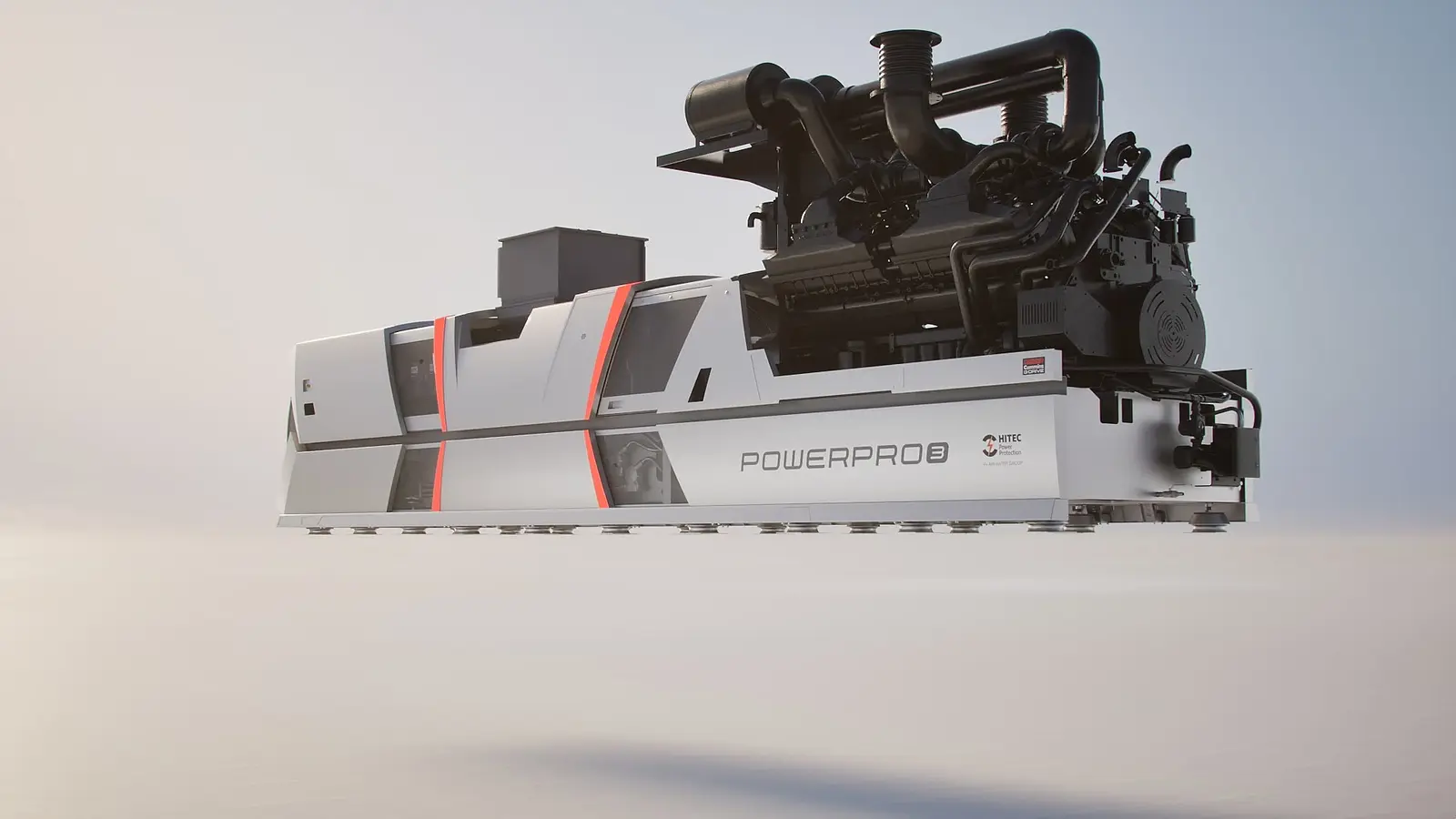
Latest generation · PowerPRO3
The PowerPRO3 is the commercial successor to the award‑winning PowerPRO2700. External dimensions and interfaces are retained, but energy module, engine and controls are new. For data centres, semiconductor fabs, hospitals, finance and critical industry.
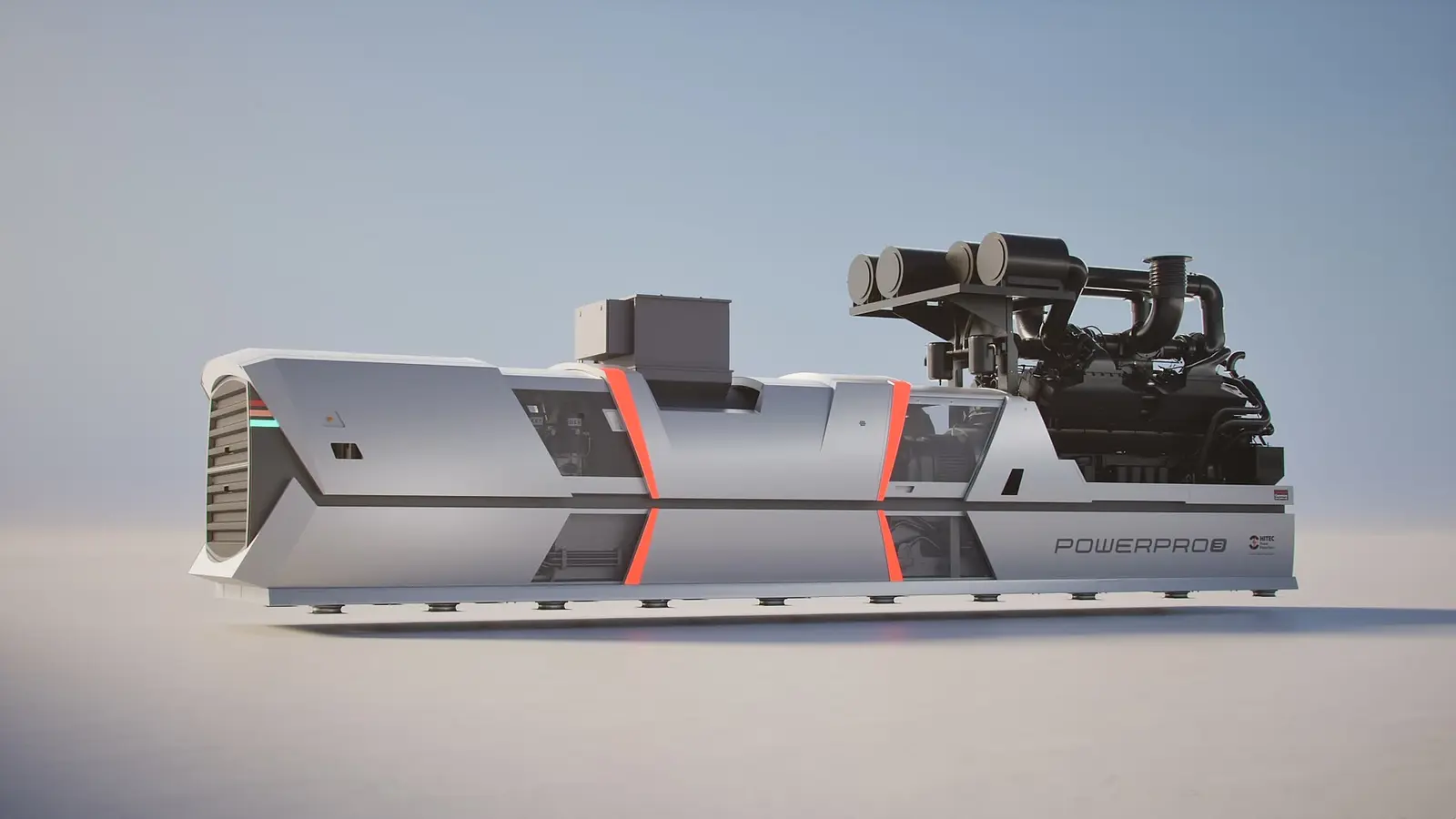
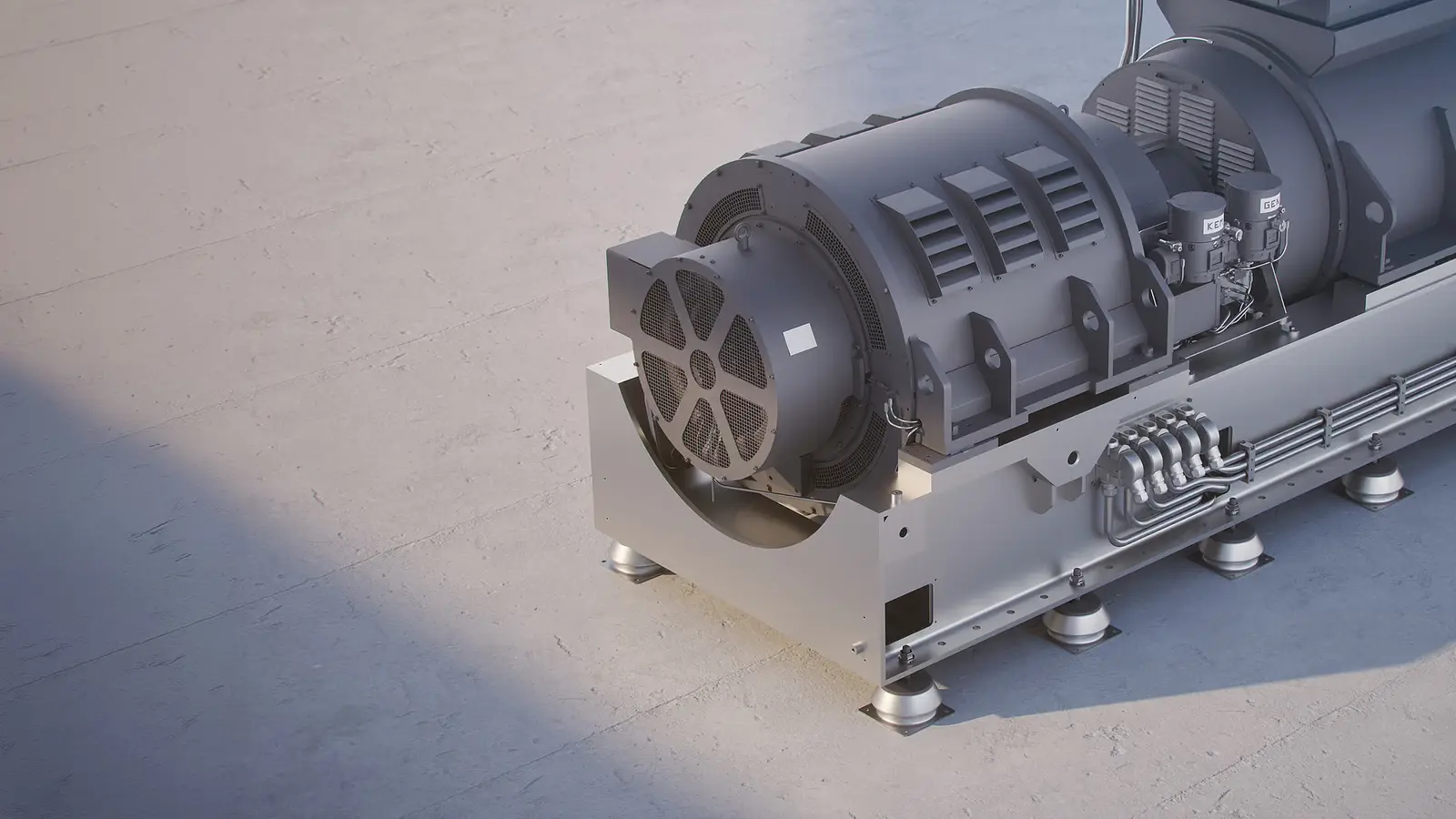
New kinetic energy module (WE‑BCD) with up to 30% more energy: inner rotor up to 4200 rpm and 500 kg more mass.
Approx. 200 kVA/m² – more no‑break power in the same footprint as the PowerPRO2700, with no new civil works.
New bearings, alternators and energy module give an efficiency of up to 97%.
More stored energy means that short utility disturbances are ridden through without starting the engine (Engine Start Delay).
Tested and approved for up to 100% HVO without modifying the machine and without loss of performance.
Sectional base frame for easy transport and installation – in a plant room or container.
Specifications
Dimension drawing
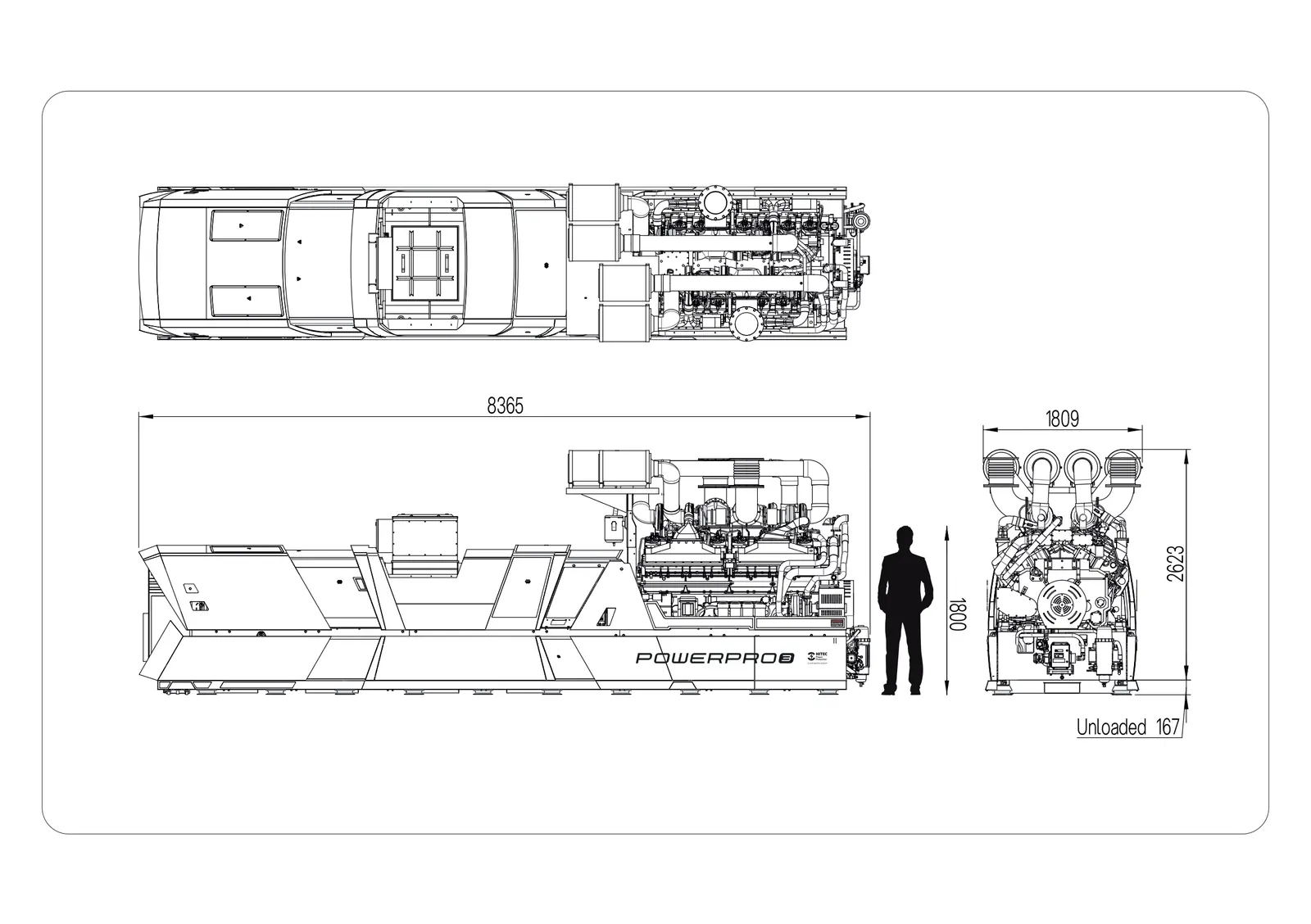
Source: HITEC PowerPRO3 specification sheet. Final dimensions and weight depend on the configuration.
Highest power per unit
The PowerPRO3600 offers the industry’s highest power density per square metre. Fewer machines for the same load mean lower installation and maintenance costs.
The energy storage consists of an Energy Transfer Module (ETM), which spins with the generator at 1500/1800 rpm, and a low‑speed flywheel at approx. 2900 rpm. ESO mode matches the stored energy to the load.
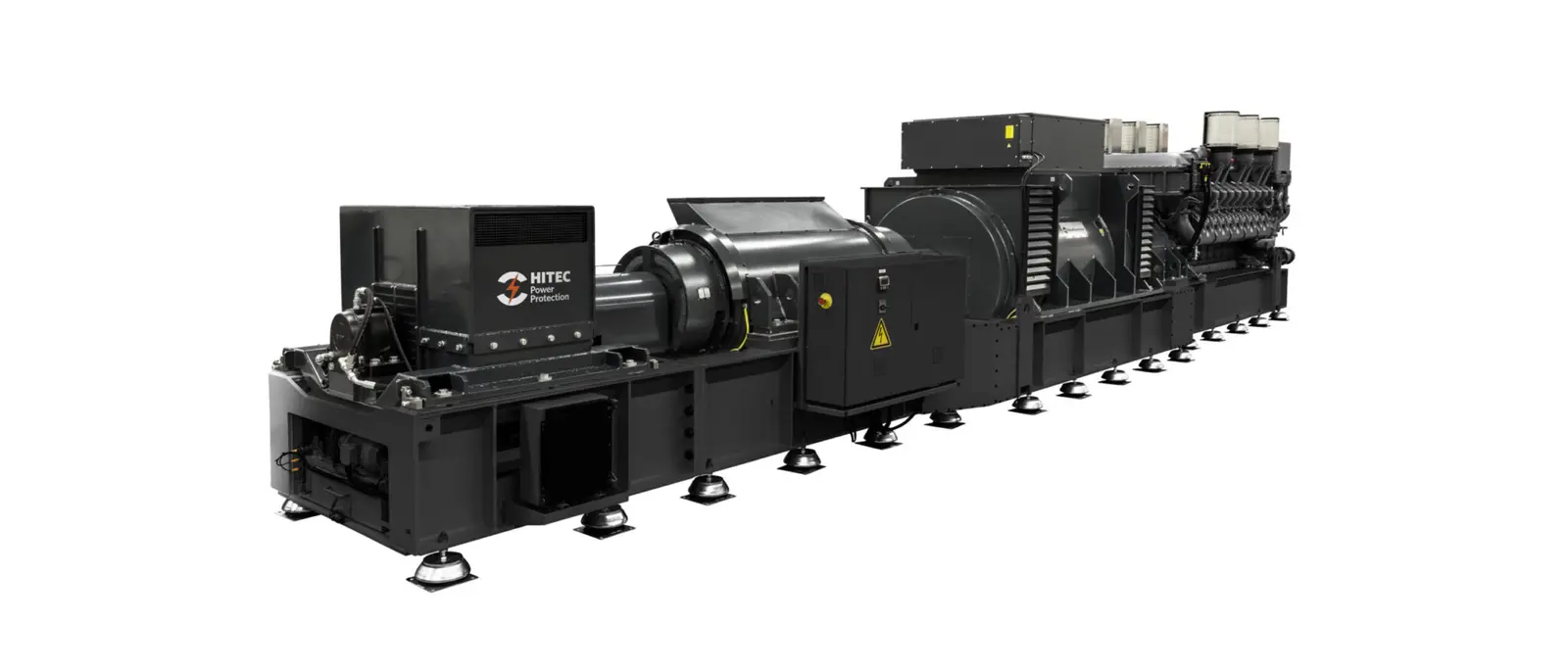
The variants cover 2,500, 2,850 and 3,000 kVA at 50 Hz and 2,500, 2,850 and 3,600 kVA at 60 Hz. The dimensions are for the machine itself without enclosure.
| Rating | Frequency | Voltage | Power | Length | Width | Height | Weight |
|---|---|---|---|---|---|---|---|
| 3,000 kVA | 50 Hz | 400 V | 2,400 kW | 11,935 mm | 2,054 mm | 2,567 mm | 38 t |
| 2,850 kVA | 50 Hz | 400 V | 2,280 kW | 11,403 mm | 2,054 mm | 2,581 mm | 37.8 t |
| 2,500 kVA | 50 Hz | 400 V | 2,000 kW | 11,181 mm | 2,054 mm | 2,737 mm | 35 t |
| 3,600 kVA | 60 Hz | 480 V | 2,880 kW | 11,963 mm | 2,058 mm | 2,567 mm | 38.6 t |
| 2,850 kVA | 60 Hz | 480 V | 2,280 kW | 11,403 mm | 2,054 mm | 2,581 mm | 37.8 t |
| 2,500 kVA | 60 Hz | 480 V | 2,000 kW | 10,780 mm | 1,721 mm | 2,547 mm | 28 t |
Source: HITEC PowerPRO3600 brochure. Each system is sized and configured to the site’s requirements; the data in the final quotation apply.
Configurations
HITEC supplies the systems in a range of standard configurations. The choice depends on the size of the load, the requirements for redundancy and concurrent maintenance, and how many separate loads must be supplied.
Generator, energy module, engine and choke are rated to deliver clean and continuous power to the critical load.
The simplest and most compact route to redundancy (typically N+1) and to very large or multiple loads on one common output bus.
Two units, each with its own group of critical loads and no common point of coupling. The controls keep them synchronised, so the tie breaker Q13 can be closed in the event of a fault or maintenance.
Two parallel systems for two independent loads with shared N+1 redundancy. Q29 links them on overload and opens on a bus fault, so the fault stays on its own side.
The units are connected to an IP ring via isolating chokes. Active power is shared, while a fault on one load is kept isolated from the others.
Each unit supplies its own load; one redundant unit takes over via closed transition instead of bypass. Requires fewer breakers and chokes than IP.
Redundancy is shared equally by all units. Each load is fed via a static transfer switch (STS) from two units, so there is no single point of failure.
Parallel N+1 system at medium voltage with a duplicated critical output (A and B). The entire system can be maintained while the load is supplied with UPS power.
The generator is oversized for short‑circuit capacity, and the surplus can supply non‑critical loads (e.g. cooling). Once the engine runs stably, Q6 closes and picks them up.
UPS unitRedundant unitTie connection
Low and medium voltage
At low voltage the systems are supplied for 380, 400, 415 and 480 V. For higher power the system is built at medium voltage – up to 22.8 kV according to the HITEC brochure and up to 35 kV for the PowerPRO3.
In both cases the breakers and the choke are at medium‑voltage level. Single output, dual output and medium voltage can be combined in most configurations.
DRUPS vs. static UPS
A traditional solution consists of a static UPS with batteries and a separate standby generator. A DRUPS combines the functions in one machine with fewer components and therefore fewer points of failure.
Static UPS + generator
DRUPS
| DRUPS (HITEC) | Static UPS + generator | |
|---|---|---|
| Energy storage | Flywheel / kinetic energy module | Batteries (lead‑acid or lithium) |
| Replacement of energy storage | None | Typically every 3–7 years in practice |
| Technical lifetime | 25 years or more | 10–15 years (economic lifetime) |
| Space requirement | 40–60% less | UPS, battery room, generator and switchboards |
| Efficiency | up to 97% (line‑interactive, no conversion) | Depends on operating mode; double conversion has conversion losses |
| Climate‑controlled room | Not needed – can stand in an unconditioned room | Batteries require a constant temperature |
| Short‑circuit capacity | High – faults are cleared without bypass | Limited by the inverter |
| Power factor towards the utility | > 0.98 (the generator supplies reactive power) | Depends on the rectifier |
| Ride‑through time | Seconds – the engine must start | Minutes – the generator can start at leisure |
DRUPS is strongest from around 1 MVA upwards, where both UPS and backup power must cover the entire facility. There are also things to take into account:
Operating features
Reduces the energy stored in the flywheel to the level the load requires, and raises it again when the load increases. It saves energy at partial load.
Short utility disturbances are ridden through on the stored energy without starting the engine. That means less fuel, fewer emissions and less wear.
All HITEC systems are certified for up to 100% HVO without modifying the machine.
Status, event history and electrical measurements collected in HITEC’s monitoring tool, with a 24/7/365 helpdesk.
2,200+ systems installed in 60 countries, more than 3,300 MVA protected – from data centres and semiconductor fabs to airports and hospitals.
HITEC Power Protection · Almelo, the Netherlands
Installation
The system is adapted to the site, the climate and the requirements for noise, fire and environment. The modular frame makes transport and installation easier, also in existing buildings.
Integrated into a new or existing building with ducted air cooling, filtration and sound attenuation.
Fully containerised outside the building – also for rental and temporary needs.
Under a weatherproof canopy on a concrete slab.
Bluecircle and HITEC
We help determine whether DRUPS is the right choice, and follow the system from engineering to operation.
Load analysis, choice of model and configuration, redundancy and voltage level.
Location, foundation, fuel, exhaust and switchboards – in cooperation with HITEC.
Functional and load tests at commissioning and as periodic testing.
Read morePreventive maintenance and service agreements that match the criticality of the system.
Read moreFAQ
A DRUPS (Diesel Rotary UPS) is a dynamic UPS in which a synchronous generator, a kinetic energy store and a diesel engine sit on the same shaft. The energy store bridges the gap until the engine has started, and the engine then supplies the load for as long as there is fuel. No batteries are used.
The HITEC PowerPRO range goes from 500 kVA to 3,600 kVA per unit: PowerPRO1000 (500–1,000 kVA), PowerPRO1800 (up to 1,700/1,800 kVA at 50/60 Hz), PowerPRO2700 (up to 2,200/2,700 kVA), PowerPRO3 (up to 2,500/3,000 kVA) and PowerPRO3600 (up to 3,000/3,600 kVA). Several units can be paralleled into systems of up to 100 MW.
The engine reaches 1500/1800 rpm in under 2 seconds, after which the freewheel clutch engages. After 5–10 seconds the engine is the sole source. Throughout, the load is supplied without interruption from the kinetic energy store.
The PowerPRO3 is the next generation of the PowerPRO2700 platform in the same footprint. A new kinetic energy module with higher speed and more mass stores up to 30% more energy, and the rating is increased to up to 2,500 kVA at 50 Hz and 3,000 kVA at 60 Hz.
Yes. All HITEC dynamic UPS systems are certified for up to 100% HVO without modifying the machine and without loss of performance.
Because the ride‑through time is seconds, the engine start and load acceptance are critical. A load bank test at commissioning and periodically afterwards shows that engine, clutch, generator and controls work under real load.
Sources: HITEC Power Protection – brochures (Technology Solutions 2023, PowerPRO3600, PowerPRO3), HITEC PowerPRO3, Hitachi Hi‑Rel – Diesel Rotary UPS. Images: HITEC Power Protection. Data may change without notice; the data in the final quotation apply.
Considering DRUPS?
Tell us about the load, the redundancy requirements and the location, and we will come back with a proposal for model and configuration.