

ZincFive · Ultra-high-rate
ZincFive BC 2-500Most power per cabinet
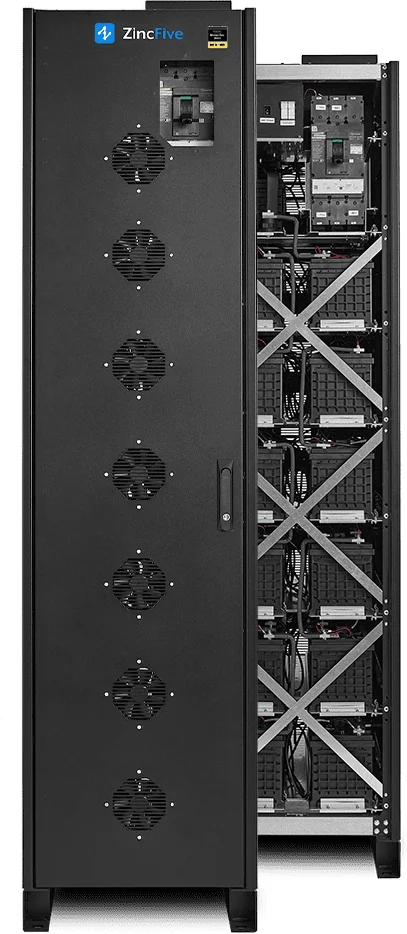
BC 2-500 is built for short backup times at high power: under 400 kW per cabinet for up to 5 minutes. Ultra-high-rate blocks of 90 Ah and a reinforced power path give up to 1,200 A discharge current. According to ZincFive, typically three cabinets are needed per MW.
Footprint
1,250 kW in 2.1 metres
When the generator takes over after a few seconds, the batteries only need to bridge a short time. Then it is the power per cabinet that decides how much space the battery system takes up.
ZincFive has compared the total width needed to deliver 1,250 kW: about 6.1 m with lead-acid batteries, 3.9 m with lithium-ion and 2.1 m with cabinets from the BC 2 series.
How we size
The backup time follows your emergency preparedness plan, not the battery's datasheet. We start from how long the UPS system must bridge until the generator has taken over, and build 25 % expansion capacity into the number of cabinets.
Nickel-zinc
When a block weakens, the string keeps running
In a string of lead-acid batteries, one worn-out block can break the entire string, so the backup is lost exactly when it is needed. A nickel-zinc block that is discharged or weakened still conducts current. The string delivers less, but it does not break.
The battery management system (BMS) monitors voltage, temperature and current on every block and on the whole string. In the event of a fault, the cabinet itself disconnects the batteries from the UPS system.
No thermal runaway
ZincFive's cells have been tested to UL 9540A with no thermal runaway in any of the tests. The electrolyte is water-based potassium hydroxide, not acid.
About half the weight of lead
A cabinet weighs about half as much as lead-acid batteries with the same power. That reduces the floor load in the UPS room.
Tolerates hot periods
The operating range is 20–35 °C. The warranty allows up to 50 °C for no more than 5 % of the operating time, for example if the cooling fails.
Nickel and zinc are recovered
According to ZincFive, all nickel and zinc can be recovered. BC 2 has a cradle-to-grave life cycle assessment from UL Solutions.
BC 2 series
Four models in the same cabinet
All four models sit in a cabinet measuring 533 × 914 mm and 2,096 mm high. The difference lies in the battery blocks, and in how much power and how long a backup time the cabinet is built for. All can be used with megawatt UPS systems, and Vertiv carries the BC series in its own range.
Technical data
ZincFive BC 2-500 in figures
Data from ZincFive's datasheet. Where values depend on the number of blocks in the string, the range is given.
| Chemistry | Nickel-zinc (NiZn), water-based potassium hydroxide electrolyte |
|---|---|
| Battery blocks | 36–39 × Z5 13-90 USF, 90 Ah, in a single string |
| Nominal voltage | 468–507 V (36–39 blocks) |
| Power per cabinet | Under 400 kW |
| Backup time | Up to 5 min |
| Max. discharge current | 1,200 A |
| Charging current | 20–160 A |
| Charging time, 0–100 % | 2–5 hours depending on the charging current |
| Dimensions (W × D × H) | 533 × 914 × 2,096 mm, 2,121 mm with high-voltage box |
| Cable entry and service | Cables enter at the top, all service from the front |
| Environment | 20–35 °C, up to 50 °C for no more than 5 % of operating time, 0–90 % relative humidity, non-condensing |
| Storage | −20 to 50 °C, no more than 6 months at 25 °C before charging |
| Cooling | Forced ventilation with fans |
| Auxiliary supply | 100–240 V AC, 50/60 Hz, additional AC or 600 V DC supply as an option |
| Communication | Ethernet and Modbus TCP/RTU |
| Breaker | Operated with the door closed, disconnects the batteries from the UPS system manually or on a fault |
| Seismic | IBC 2021 and ICC AC156 (SDS 2.29 g) |
| Weight | Up to 971 kg |
| Standards | IEC 62040-1, IEC 62040-2, CE, UKCA and RoHS, UL 1973 and UL 1778, cells tested to UL 9540A |
| Warranty | 10 years at string level at up to 35 °C |
Sources: ZincFive BC 2 Series datasheet MKT-LIT-0062 rev. 4.0 (2025), BC 2 AI datasheet rev. 2.0 (2026), ZincFive's model overview and FAQ for the BC series (April 2026), life cycle assessment for BC 2 (UL Solutions, 2026) and Vertiv's product page for BC 2 (warranty).
Bluecircle
From sizing to operation
We size the battery system according to your emergency preparedness plan, deliver and commission it, and service it afterwards with a fixed response time.
Should BC 2-500 be sized for your UPS system?
Send us the power of the UPS system, the required backup time and the level of redundancy. We will get back to you with a sizing and a quotation.