

New · ZincFive
ZincFive BC 2 AIBattery cabinet for AI data centres
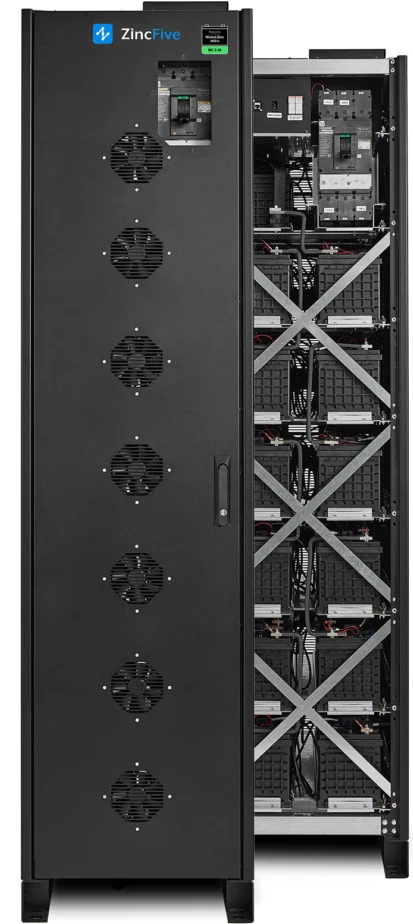
GPU clusters draw power in rapid peaks. BC 2 AI absorbs the peaks and is also backup during a power outage, in the same cabinet. The cabinet has ZincFive's new 90 Ah nickel-zinc blocks and a battery management system that registers the load in real time.
AI load
The power peaks are handled at the UPS system
When an AI model is trained, the power fluctuates in step with the GPUs' calculations. According to ZincFive, the peaks can reach 150 % of the UPS system's rated power. Without storage close to the load, they must be supplied by the UPS system, grid and generator, which must then be sized for the peaks.
BC 2 AI sits at the UPS system and supplies the peaks from the batteries. The grid and generator see a smoother load, and the same battery string is still backup during a power outage.
How we size
We map the load profile before we size: how large the peaks are, how often they occur, and how long a backup time the emergency preparedness plan requires. Only then do we determine the number of cabinets.
Nickel-zinc
When a block weakens, the string keeps running
In a string of lead-acid batteries, one worn-out block can break the entire string, so the backup is lost exactly when it is needed. A nickel-zinc block that is discharged or weakened still conducts current. The string delivers less, but it does not break.
The battery management system (BMS) monitors voltage, temperature and current on every block and on the whole string. In the event of a fault, the cabinet itself disconnects the batteries from the UPS system.
No thermal runaway
ZincFive's cells have been tested to UL 9540A with no thermal runaway in any of the tests. The electrolyte is water-based potassium hydroxide, not acid.
About half the weight of lead
A cabinet weighs about half as much as lead-acid batteries with the same power. That reduces the floor load in the UPS room.
Tolerates hot periods
The operating range is 20–35 °C. The warranty allows up to 50 °C for no more than 5 % of the operating time, for example if the cooling fails.
Nickel and zinc are recovered
According to ZincFive, all nickel and zinc can be recovered. BC 2 has a cradle-to-grave life cycle assessment from UL Solutions.
BC 2 series
Four models in the same cabinet
All four models sit in a cabinet measuring 533 × 914 mm and 2,096 mm high. The difference lies in the battery blocks, and in how much power and how long a backup time the cabinet is built for. All can be used with megawatt UPS systems, and Vertiv carries the BC series in its own range.
Technical data
ZincFive BC 2 AI in figures
Data from ZincFive's datasheet. Where values depend on the number of blocks in the string, the range is given.
| Chemistry | Nickel-zinc (NiZn), water-based potassium hydroxide electrolyte |
|---|---|
| Battery blocks | 37–39 × Z5 13-90 USF, 90 Ah, in a single string |
| Nominal voltage | 481–507 V (37–39 blocks) |
| Power per cabinet | 280–325 kW |
| Backup time | Over 5 min, plus millions of short power pulses |
| Max. discharge current | 800 A |
| Charging current | 20–160 A |
| Charging time, 0–100 % | 2–5 hours depending on the charging current |
| Dimensions (W × D × H) | 533 × 914 × 2,096 mm, 2,121 mm with high-voltage box |
| Cable entry and service | Cables enter at the top, all service from the front |
| Environment | 20–35 °C, up to 50 °C for no more than 5 % of operating time, 0–90 % relative humidity, non-condensing |
| Storage | −20 to 50 °C, no more than 6 months at 25 °C before charging |
| Cooling | Forced ventilation with fans |
| Auxiliary supply | 100–240 V AC, 50/60 Hz, additional AC or 600 V DC supply as an option |
| Communication | Ethernet and Modbus TCP/RTU |
| Breaker | Operated with the door closed, disconnects the batteries from the UPS system manually or on a fault |
| Seismic | IBC 2021 and ICC AC156 (SDS 2.29 g) |
| Weight | Up to 966 kg |
| Standards | IEC 62040-1, IEC 62040-2, CE, UKCA and RoHS, UL 1973 and UL 1778, cells tested to UL 9540A and EU Battery Regulation 2023/1542 |
| Warranty | 10 years at string level at up to 35 °C |
Sources: ZincFive BC 2 Series datasheet MKT-LIT-0062 rev. 4.0 (2025), BC 2 AI datasheet rev. 2.0 (2026), ZincFive's model overview and FAQ for the BC series (April 2026), life cycle assessment for BC 2 (UL Solutions, 2026) and Vertiv's product page for BC 2 (warranty).
Bluecircle
From sizing to operation
We size the battery system according to your emergency preparedness plan, deliver and commission it, and service it afterwards with a fixed response time.
Should BC 2 AI be sized for your UPS system?
Send us the power of the UPS system, the required backup time and the level of redundancy. We will get back to you with a sizing and a quotation.